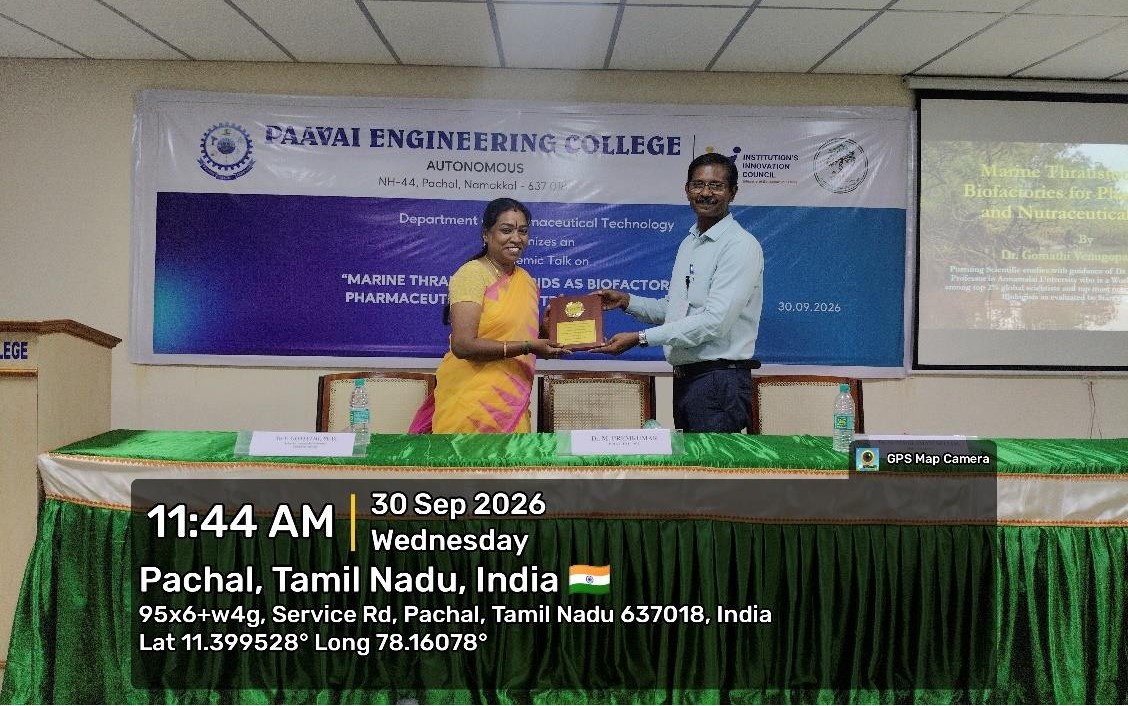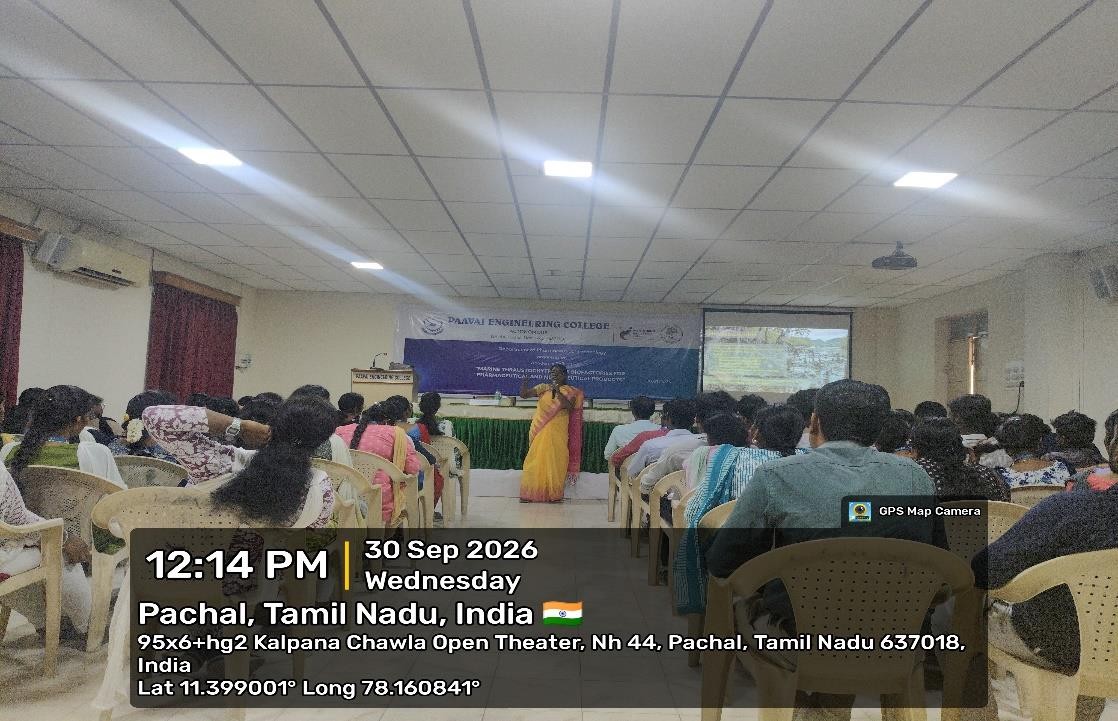
The Department of Pharmaceutical Technology, Paavai Engineering College (Autonomous), Namakkal, successfully organized an Academic Talk on “Marine Thraustochytrids as Biofactories for Pharmaceutical and Nutraceutical Products” on 30 September 2026 at Cute Hall. The programme was held from 10.00 a.m. to 1.00 p.m. and was attended by 130 students and faculty members.
The programme was held under the patronage of Dr. M. Premkumar, Principal, with Dr. M. Masilamani Selvam, Head of the Department, as Convenor and Ms. J.L. Aarthi, Assistant Professor, as Coordinator. The gathering was warmly welcomed, and the guest speaker was introduced to the audience. The resource person, Dr. V. Gomathi, Ph.D., Scientist, Annamalai University, Cuddalore District, holds a doctorate in Coastal Aquaculture from the Centre of Advanced Study in Marine Biology, Annamalai University. Her research on thraustochytrids from the mangrove biotope and their production of polyunsaturated fatty acids (PUFA) has been published in several peer-reviewed journals, and she has received awards for her research presentations at national and international conferences.
In her informative address, Dr. Gomathi introduced thraustochytrids as single-celled marine protists found abundantly in mangrove sediments, decomposing leaf litter and coastal waters, where they play an important role as decomposers. She explained that genera such as Schizochytrium, Aurantiochytrium and Thraustochytrium accumulate high levels of docosahexaenoic acid (DHA), offering a sustainable and contaminant-free alternative to fish oil. She highlighted the value of DHA and related fatty acids in supporting cardiovascular, neurological and visual health, and their use in dietary supplements, functional foods and infant nutrition. The speaker also spoke about other bioactive compounds from these organisms, such as squalene and carotenoids, which show antioxidant and antimicrobial properties.
Dr. Gomathi further explained how thraustochytrids can be cultured in bioreactors on low-cost carbon and nitrogen sources, making large-scale and season-independent production possible, and how salinity, temperature, pH, vitamins and nutrient ratios influence biomass and lipid
yield. Participants learned about the isolation of strains from mangrove habitats, culture optimization, lipid extraction and analysis by chromatographic methods such as GC-MS, and molecular identification of strains. Emerging applications, including nanoparticle synthesis and the bioremediation of dyes and heavy metals, were also discussed.
The session concluded with an interactive discussion in which students raised questions on strain selection, downstream processing and commercial prospects, which the speaker answered with examples from her own research. The talk gave the participants a clear understanding of marine microbes as a renewable bioresource for drug and nutraceutical development and encouraged them to explore research opportunities in marine biotechnology.
The academic talk successfully created awareness about the potential of marine microorganisms in pharmaceutical and nutraceutical research, contributing to PO 1, 2, 3, PSO 1, 2 and SDG 3, 4, 9 and 12. The Department expressed its sincere gratitude to Dr. V. Gomathi for sharing her expertise and to the Principal, faculty members and student volunteers for their support in conducting the programme.