The Department of Robotics and Automation, Paavai Engineering College (Autonomous), organised an online Alumni Guest Lecture titled “Emerging Technologies for Industry 4.0 and Smart Manufacturing” on 10 October 2026, from 10.00 a.m. to 11.30 a.m. The resource person was Mr. R. M. Shanmuganathan, PLC Service Engineer at BASE Automation Technologies Private Limited, Chennai, and an alumnus of Paavai College of Technology, Robotics and Automation, Batch 2021–2025. The lecture focused on the evolution of industrial manufacturing and the role of emerging technologies in connected, data-driven and adaptive production systems.
The session covered the progression from Industry 1.0 to Industry 4.0 and highlighted key enabling technologies, including the Industrial Internet of Things (IIoT), artificial intelligence and machine learning, digital twins, edge and cloud computing, collaborative robots, additive manufacturing, 5G connectivity, augmented/virtual reality and industrial cybersecurity. The smart-factory workflow—sensing, connectivity, data analysis, decision-making and action—was discussed to illustrate how machine data can support monitoring, predictive maintenance and production optimisation.
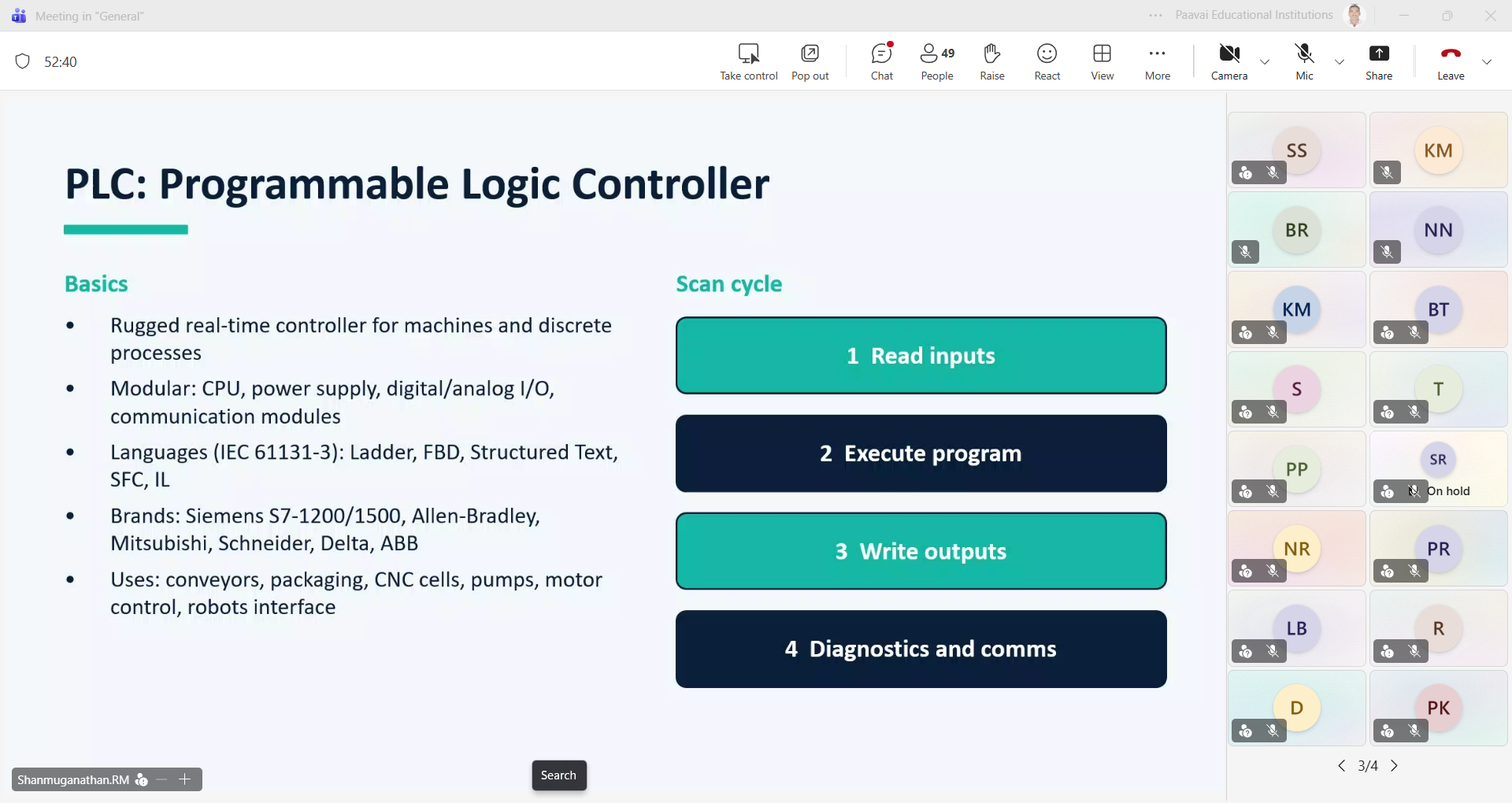
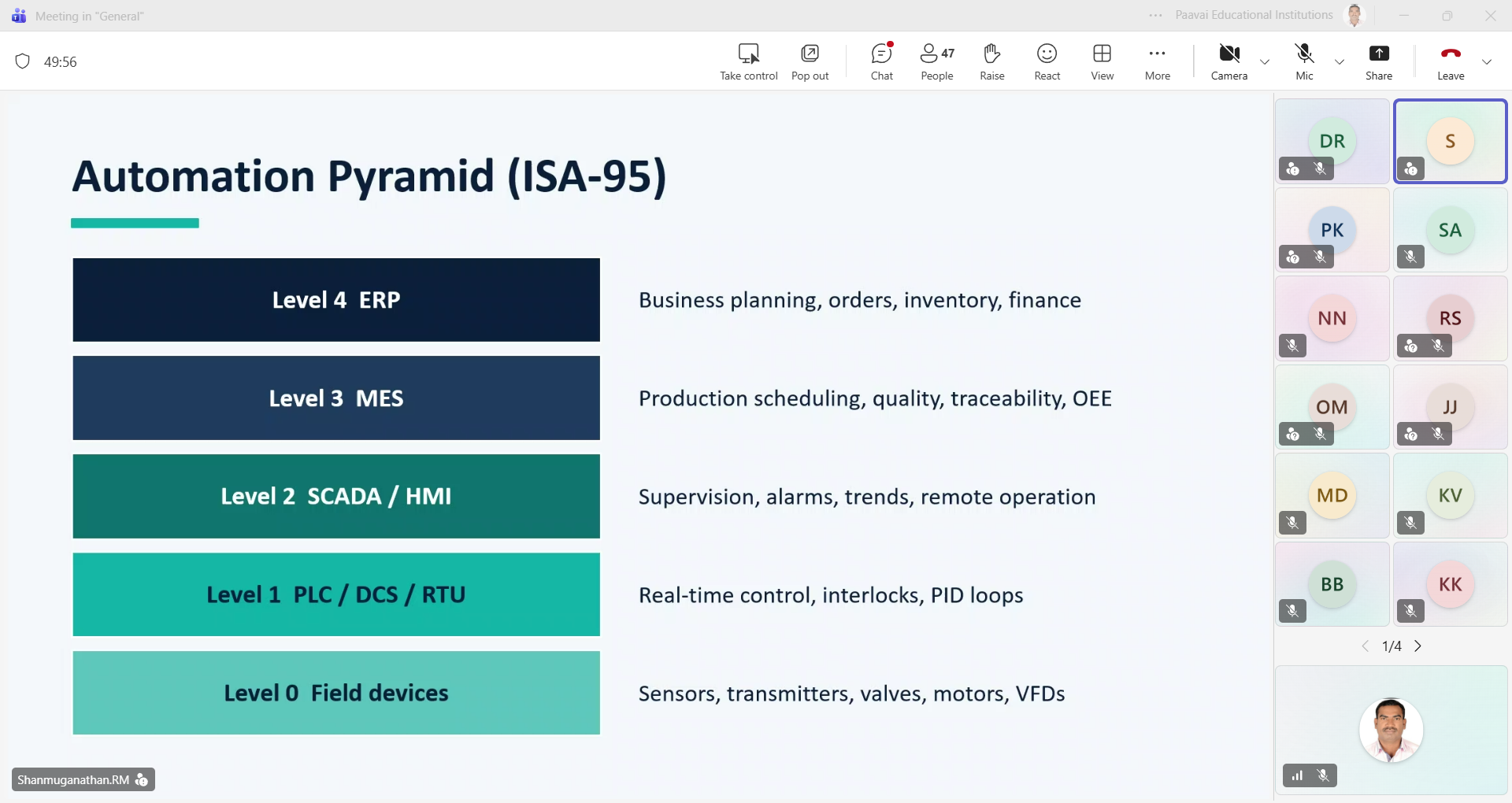
The lecture introduced the industrial automation pyramid (ISA-95) and explained the roles of Programmable Logic Controllers (PLCs), Supervisory Control and Data Acquisition (SCADA) systems, and Distributed Control Systems (DCS). Industrial communication technologies and protocols, including Modbus, Profinet, EtherNet/IP, OPC UA and MQTT, were discussed in the context of connecting operational technology with information technology. The session also addressed the benefits and challenges of smart manufacturing, including productivity, quality, downtime reduction, legacy-system integration, cybersecurity and the need for industry-relevant skills.
The lecture helped students relate robotics and automation concepts to current industrial practices and identify career pathways in automation, industrial data analytics, embedded systems, robotics and industrial software. Students were encouraged to strengthen their practical skills through mini-projects, internships and continuous learning.
Outcome: Students gained an overview of Industry 4.0 technologies, industrial automation architecture, smart-factory data flow and technical skills increasingly expected in modern manufacturing. The programme also strengthened the connection between alumni experience and students’ career awareness.
SDG Mapping: SDG 4 – Quality Education; SDG 8 – Decent Work and Economic Growth; SDG 9 – Industry, Innovation and Infrastructure; SDG 12 – Responsible Consumption and Production.