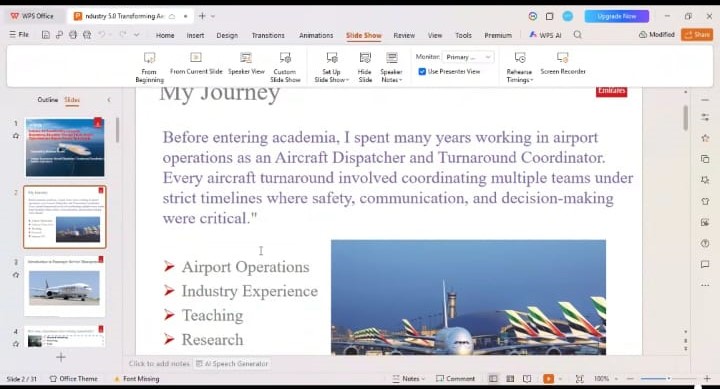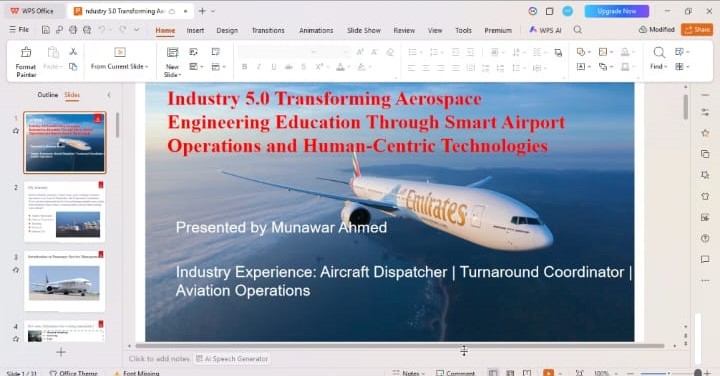
The Department of Aeronautical Engineering, Paavai Engineering College (Autonomous), Pachal, Namakkal, successfully organized a One-Day Online Faculty Development Programme (FDP) on 21st July 2026 from 11:30 AM to 1:00 PM. The programme was conducted through an online platform with the objective of enhancing awareness among faculty members, research scholars, and postgraduate students about the emerging concepts of Industry 5.0 and its impact on engineering education and aerospace research. The event was organized under the guidance of Dr. M. Premkumar, Principal, with Dr. R. Arravind, Professor & Head, Department of Aeronautical Engineering, serving as the Convenor. The programme was coordinated by Mrs. S. Marypriya and Mr. S. Sudhagar, Assistant Professors, Department of Aeronautical Engineering.
The keynote session was delivered by Mr. Munawar Ahmed, Senior Assistant Professor, Department of BBA Aviation Management, HKBK Degree College, Manyata Tech Park, Bengaluru, and an alumnus of Paavai Engineering College. During his insightful presentation, the speaker explained the significance of Industry 5.0, highlighting the transition from automation-centric manufacturing to a human-centric, sustainable, and resilient industrial ecosystem. He elaborated on the integration of advanced technologies such as Artificial Intelligence (AI), Digital Twins, Internet of Things (IoT), Robotics, Smart Manufacturing, and Data Analytics in aerospace engineering. The session also emphasized the importance of interdisciplinary research, innovation-driven education, and industry–academia collaboration to prepare future-ready aerospace engineers.
The FDP witnessed the active participation of approximately 80 faculty members, research scholars, and students from various institutions. The interactive session enabled participants to clarify their queries regarding the implementation of Industry 5.0 technologies in teaching, research, curriculum development, and aerospace applications. Participants appreciated the practical insights shared by the resource person and gained a comprehensive understanding of emerging technological trends shaping the future of engineering education.
The programme successfully achieved its objectives by enhancing participants’ knowledge of Industry 5.0 concepts, encouraging innovative teaching methodologies, promoting multidisciplinary research, and creating awareness of sustainable and human-centric engineering solutions. The FDP also reinforced the importance of continuous learning and collaboration with industry to develop competent engineering professionals capable of addressing future technological challenges. The programme concluded with a vote of thanks expressing gratitude to the management, resource person, organizing committee, and all participants for making the event a grand success. Participants were provided with E-certificates for their active participation.