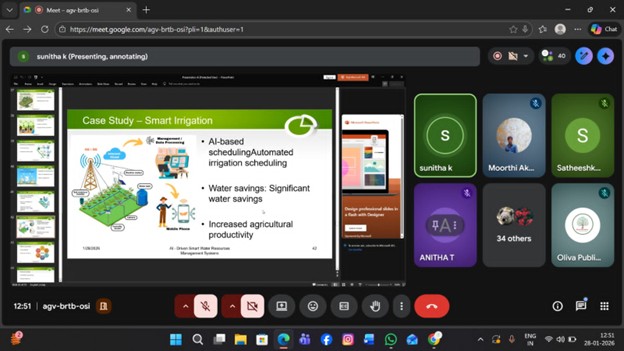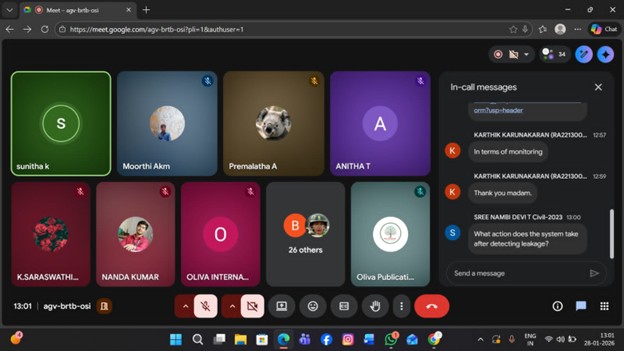
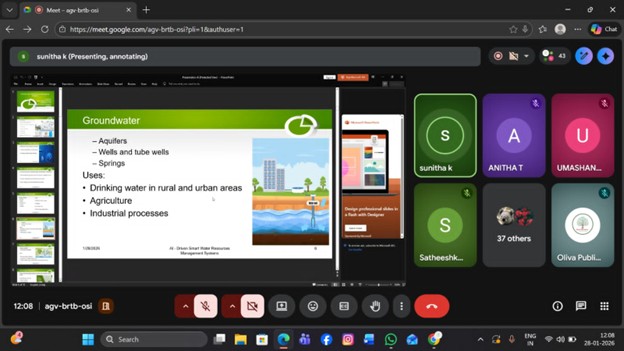
The Department of Agricultural Engineering, in collaboration with Oliva International Publication, organized a one-day Faculty Development Program (FDP) on ‘AI-Driven Smart Water Resources Management Systems’ on January 28th, 2026, conducted online via the Google Meet platform. The event brought together faculty members, researchers, and participants from various institutions, focusing on the application of artificial intelligence (AI) in water resource management.
The program commenced with a warm welcome by Mr. Dhanush K J, a third-year Agricultural Engineering student, who set the tone for the webinar. The presidential address was delivered by Dr. M. Premkumar, Principal of Paavai Engineering College, who emphasized the significant role of agricultural engineers in driving innovation and implementing smart automation tools in the field. He highlighted the importance of adopting AI technologies to address the growing challenges in agricultural water management.
Dr. B. KailashKumar, Head of the Department of Agricultural Engineering, organized the event and delivered an insightful session on the latest trends in agricultural innovations. He shared valuable insights on the current patterns of agricultural innovation and the role of academic journals in disseminating new knowledge. His talk was well-received, and the participants appreciated his deep knowledge of the field.
The introduction of the Chief Guest, Mrs. K. Sunitha, Assistant Professor (Senior Grade), Department of Computer Science Engineering, CMR University, Bangalore, was presented by Ms. Mythili C, a third-year Agricultural Engineering student. Mrs. Sunitha, the keynote speaker, delivered an inspiring talk on the role of AI in managing water resources efficiently and sustainably. She focused on the application of AI tools such as machine learning, Internet of Things (IoT), Geographic Information Systems (GIS), and remote sensing for enhanced monitoring, forecasting, and decision-making. Her session provided valuable insights into the potential of these technologies for addressing global water challenges.
The FDP session proved to be an eye-opener for the participants, enhancing their understanding of how AI-driven solutions can revolutionize water resource management in agriculture. The event concluded with a vote of thanks by Mr. A. Meignanamoorthi, Assistant Professor of Agricultural Engineering, who expressed gratitude to all the speakers, organizers, and participants.
Overall, the FDP was a great success, with more than 100 faculty members and researchers from various colleges attending the program. The knowledge gained from the session will undoubtedly empower the participants to contribute to the development and application of innovative AI-driven solutions in agricultural water management.