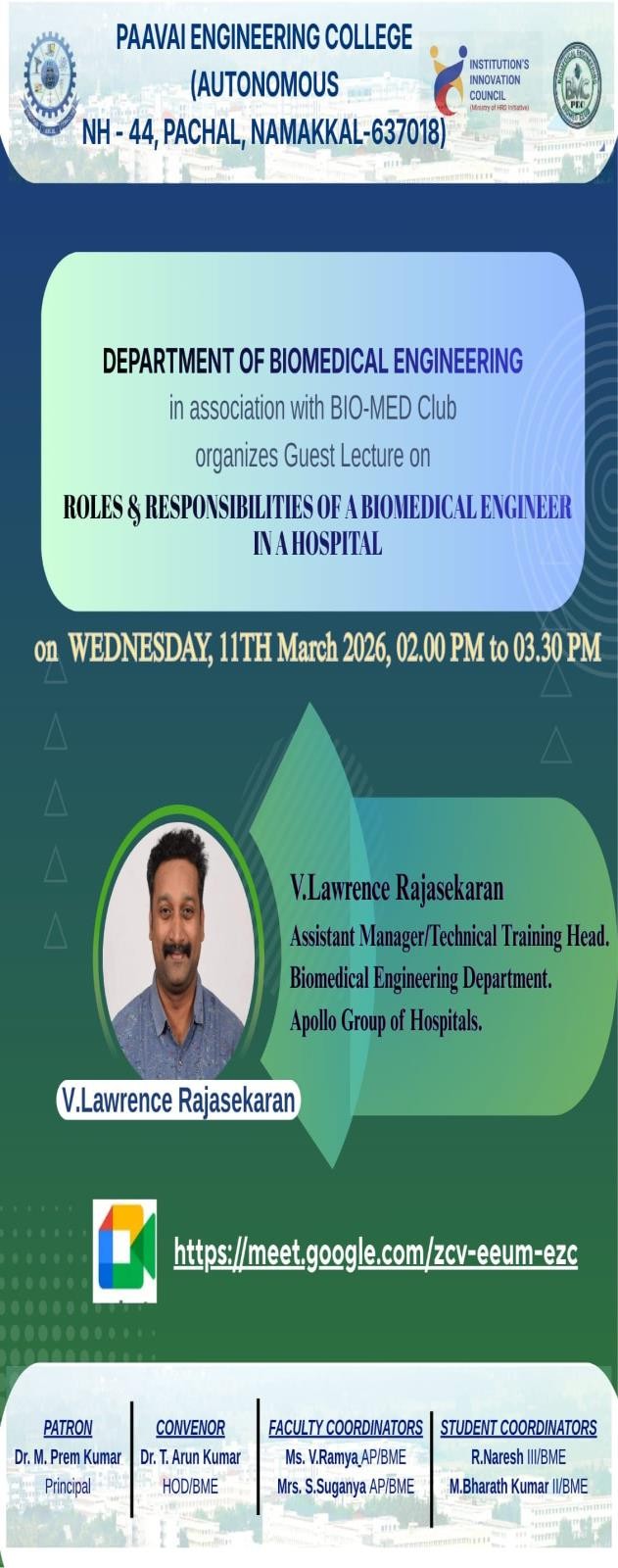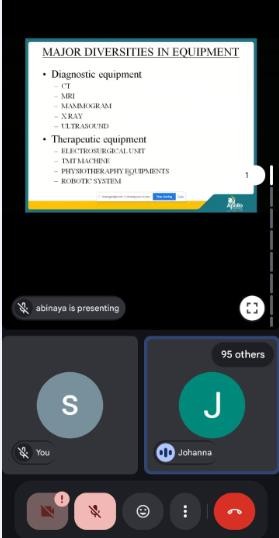

The Department of Biomedical Engineering and in Associate with BIO- MED club conducted a guest lecture on the topic “Roles and responsibilities of a Biomedical Engineering in a Hospital” dated on 11.03.2026. The session was delivered by V. Lawrence Rajasekaran, Assistant Manager and Technical Training Head at Apollo Hospitals, Chennai. The lecture provided valuable insights into the practical roles of biomedical engineers in healthcare institutions. During the session, the speaker explained the various responsibilities of biomedical engineers in hospitals, including equipment maintenance, procurement, installation, documentation, asset management, and safety management. He emphasized that biomedical engineer’s play a crucial role in ensuring that medical equipment functions efficiently and safely for patient care. The speaker also highlighted the process of equipment procurement, which includes preparing technical specifications, inviting quotations or tenders, evaluating equipment based on cost and performance, and selecting suitable medical devices for hospital use. The lecture further explained the importance of preventive maintenance in medical equipment management. Preventive maintenance involves systematic inspection and servicing of equipment to detect and correct potential faults before they lead to failure. Activities such as electrical safety testing, cleaning, calibration, and replacement of damaged parts are included in this process. The speaker also discussed equipment maintenance schedules based on international guidelines such as Emergency Care Research Institute (ECRI) and Global Medical Device Nomenclature Agency (GMDN), where equipment is classified as critical, semi-critical, and non- critical depending on maintenance frequency. In addition, the speaker described the major categories of hospital equipment, including diagnostic equipment such as CT, MRI, mammography, X-ray, and ultrasound, as well as therapeutic equipment such as electrosurgical units, TMT machines, physiotherapy equipment, and robotic systems. The importance of electrical safety testing using electrical safety analyzers was also explained to ensure patient and operator safety. The session was highly informative and helped students understand the real-time responsibilities and challenges faced by biomedical engineers in hospitals. The lecture also motivated students to develop technical skills and gain practical exposure in the field of biomedical engineering. The session concluded with an interactive discussion, where students clarified their doubts regarding hospital equipment management and career opportunities in the healthcare industry. Overall, the guest lecture was highly beneficial and provided valuable industry-oriented knowledge to the students.