The Departments of Information Technology (IT) and Cyber Security, Paavai Engineering College, successfully organized a Virtual Faculty Development Programme (FDP) titled “AI-Driven Automation: Transforming Next-Generation Industrial Growth and Academic Excellence” from 23rd March 2026 to 28th March 2026. The Six-days programme aimed to enhance faculty understanding of AI-Driven automation and its role in Next-Generation Industrial Growth.
The programme commenced with a welcome address delivered by Dr. B. Venkatesan, HOD, IT. The Presidential Address by Dr. R. R. Krishnamurthy, underscore the transformative potential of intelligent automation in reshaping industrial ecosystems. The chief guests for the sessions were introduced by Dr. P. Muthusamy, HOD, Cyber Security. Dr. Sankara Subramaniam delivered an insightful keynote address, focusing on responsible AI practices, implementation challenges, and emerging trends.
Day 1 – 23.03.2026
Session Title: Responsible AI for Intelligent Automation
Resource Person:
Dr. P. Karthikeyan,
Associate Professor,
School of Computer Science and Engineering,
RV University,
Bengaluru
Time: 2:30 PM – 4:30 PM
Session Summary:
The session focused on the principles of responsible Artificial Intelligence and its integration into modern automation systems. It emphasized ethical considerations such as fairness, transparency, and accountability in AI-driven processes. The speaker illustrated how bias in AI models can affect decision-making and highlighted methods to mitigate such risks. Practical examples were shared to demonstrate real-world AI implementations and their challenges. Overall, the session provided participants with a strong foundation in designing ethical and sustainable AI solutions.
Day 2 – 24.03.2026
Session Title: SelfMemory – Universal Memory Layer for your AI Agents
Resource Person:
Mr. Shrijayan Rajendran,
AI Engineer,
ThoughtWorks,
Bangalore
Time: 2:30 PM – 4:30 PM
Session Summary:
This session introduced the concept of memory layers in Artificial Intelligence agents and their importance in enhancing performance. The speaker explained how SelfMemory enables AI systems to retain context and improve decision-making capabilities over time. Architectural aspects of designing intelligent agents were discussed with practical examples. The session also covered real-time applications where adaptive AI systems are used effectively. Participants gained valuable insights into building scalable and efficient AI agents with memory capabilities.
Day 3 – 25.03.2026
Session Title: AI-Driven Automation in Smart Cities and Healthcare
Resource Person:
Dr. Krishna Kant Agrawal,
Professor, CSE & Associate Dean (Research),
School of Computer Science and Engineering,
Galgotias University,
Greater Noida, India
Time: 2:30 PM – 4:30 PM
Session Summary:
The session explored the transformative role of Artificial Intelligence in smart cities and healthcare systems. It highlighted applications such as intelligent traffic management, energy optimization, and AI-based healthcare diagnostics. Real-world case studies were presented to demonstrate how AI improves efficiency and decision-making. The speaker also discussed challenges in implementation, including data privacy and infrastructure limitations. Participants gained a comprehensive understanding of how AI contributes to building smarter and more sustainable environments.
Day 4 – 26.03.2026
Session Title: Extracting Scientific Knowledge from Research Articles to Build an Open Research Knowledge Graph
Resource Person:
Dr. Sanju Tiwari,
Professor,
Sharda University,
Greater Noida, India
Time: 2:30 PM – 4:30 PM
Session Summary:
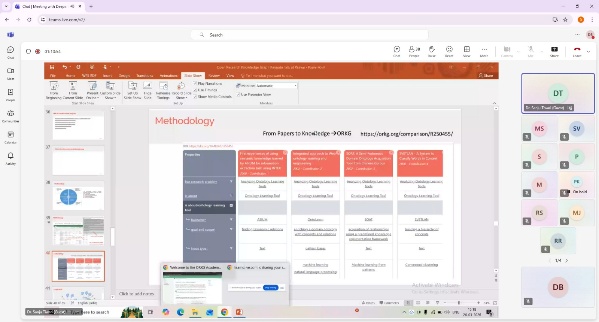
This session focused on transforming unstructured research data into structured knowledge using Artificial Intelligence techniques. The speaker introduced concepts such as natural language processing, semantic analysis, and knowledge graph construction. She explained how large volumes of research articles can be processed and organized efficiently. Practical approaches to extracting meaningful insights from academic content were discussed. The session enabled participants to understand the significance of knowledge representation in research and innovation.
Day 5 – 27.03.2026
Session Title: Intelligent Automation with AI: Bridging Smart Industry and Academic Transformation
Resource Person:
Dr. Partheeban Nagappan,
Professor,
Computer Science Engineering,
SRM Institute of Science and Technology,
Delhi-NCR,
Modinagar,
Uttar Pradesh
Time: 2:30 PM – 4:30 PM
Session Summary:
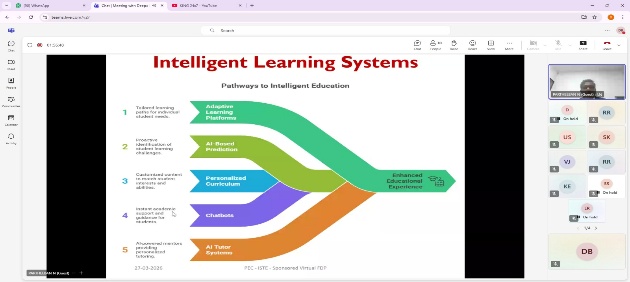
The session highlighted the integration of Artificial Intelligence in industrial and academic domains to enhance productivity and innovation. The speaker discussed how intelligent automation is reshaping workflows and decision-making processes. Real-world industrial applications were presented to demonstrate the effectiveness of AI-driven solutions. The importance of aligning academic curricula with industry requirements was also emphasized. Participants gained valuable insights into bridging the gap between theoretical knowledge and practical implementation.
Day 6 – 28.03.2026
Session Title: AI-Driven Automation Systems: Architecture, Risks, and Responsible Deployment
Resource Person:
Mr. Muralidharan Deenathayalan,
Director – Solution Architecture & Technology,
Cloud & AI Strategy,
Ryval-X,
Coimbatore
Time: 2:30 PM – 4:30 PM
Session Summary:
The session provided an in-depth understanding of AI system architecture and its role in automation. The speaker discussed key design principles, including scalability, reliability, and efficiency in AI systems. Potential risks such as data security, bias, and ethical concerns were also addressed. Strategies for responsible AI deployment and governance were explained with practical examples. Participants gained a clear perspective on designing robust and secure AI solutions for real-world applications.