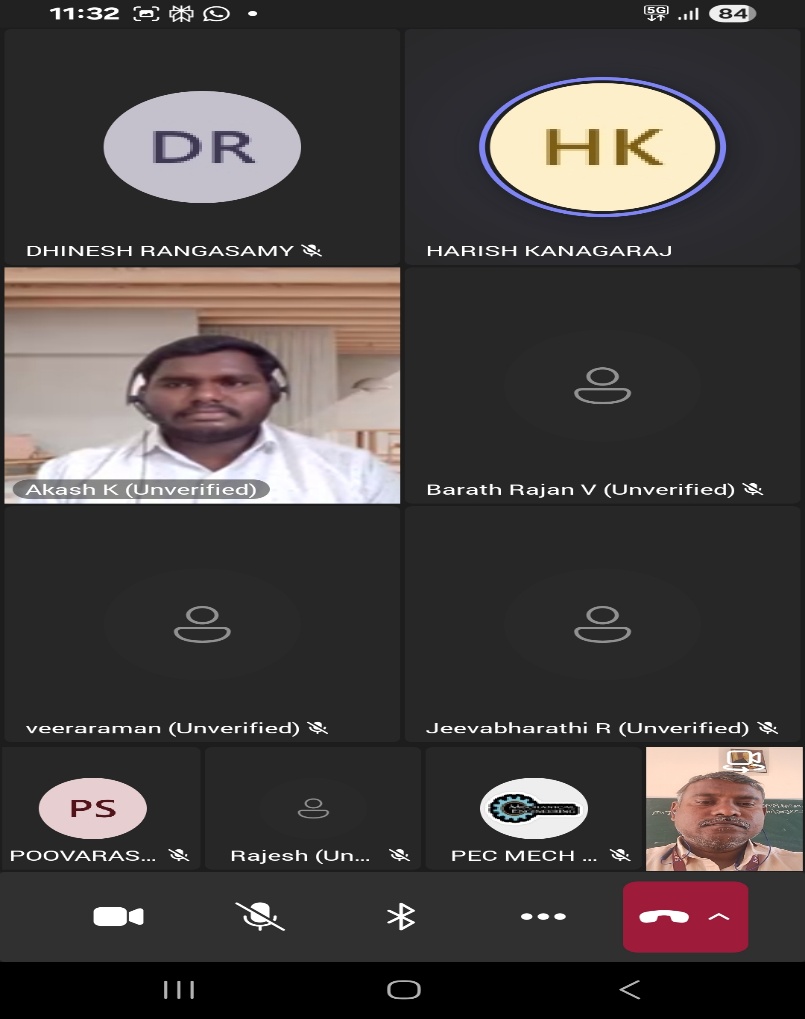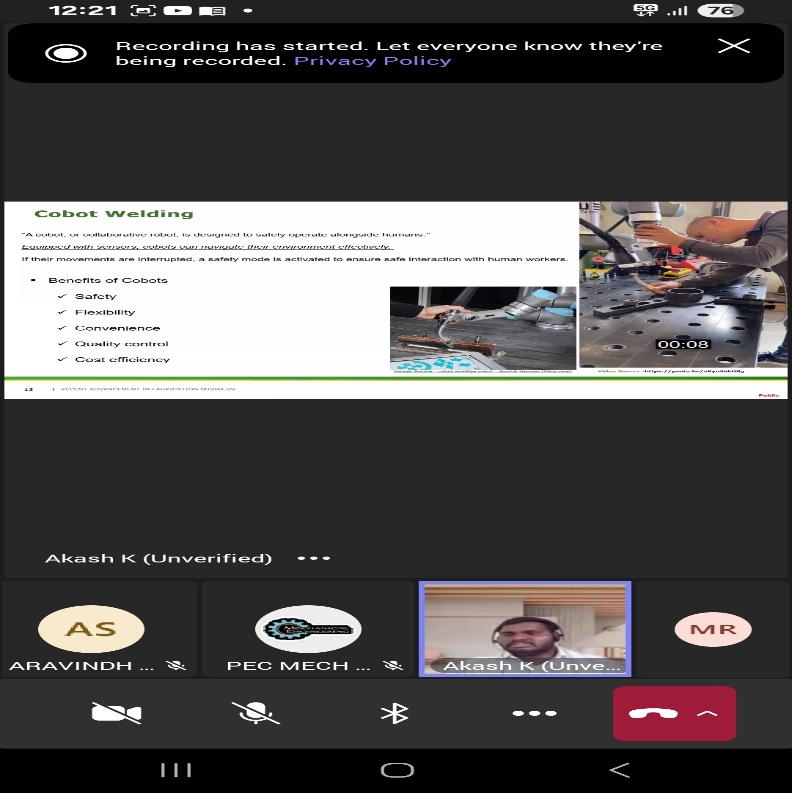
The Department of Mechanical Engineering, Paavai Engineering College (Autonomous), Namakkal, successfully organized an Alumni Guest Lecture on “Recent Advancements in Fabrication Process” on 22 January 2026, from 11.00 a.m. to 12.30 p.m. The program was conducted under the initiative of the Resource Club with the objective of enhancing students’ knowledge of modern industrial practices and emerging trends in fabrication technology.
The session was delivered by Mr. Akash K, an alumnus of the Department of Mechanical Engineering and currently working as a Weld Manufacturing Engineer at John Deere India Pvt. Ltd., Pune. The program commenced with a warm welcome to the guest speaker, followed by an introductory address highlighting his professional achievements and industry experience.
During the lecture, Mr. Akash K elaborated on recent developments in fabrication processes, with special emphasis on advanced welding techniques, automation in manufacturing, quality control practices, and the role of fabrication in large-scale industrial production. He shared real-time industrial case studies from John Deere, which helped students understand the practical applications of theoretical concepts. The session also covered current industry expectations, skill requirements for mechanical engineers, and the importance of adapting to new technologies in manufacturing sectors.
The lecture was highly interactive, with students actively participating and raising questions related to fabrication challenges, career opportunities in manufacturing industries, and the transition from academics to industry. The speaker provided insightful answers and offered valuable guidance on career planning, skill development, and continuous learning.
The program was coordinated by Mr. R. Mohanraj, AP/Mech, and Mr. N. Manigandan, AP/Mech. The event was convened by Dr. A. P. Sivasubramaniam, HoD – Mechanical Engineering, under the patronage of Dr. M. Premkumar, Principal, Paavai Engineering College.
Overall, the alumni guest lecture was highly informative and beneficial to the students. It successfully bridged the gap between academic learning and industrial practices, motivating students to prepare themselves for future challenges in the field of mechanical engineering.