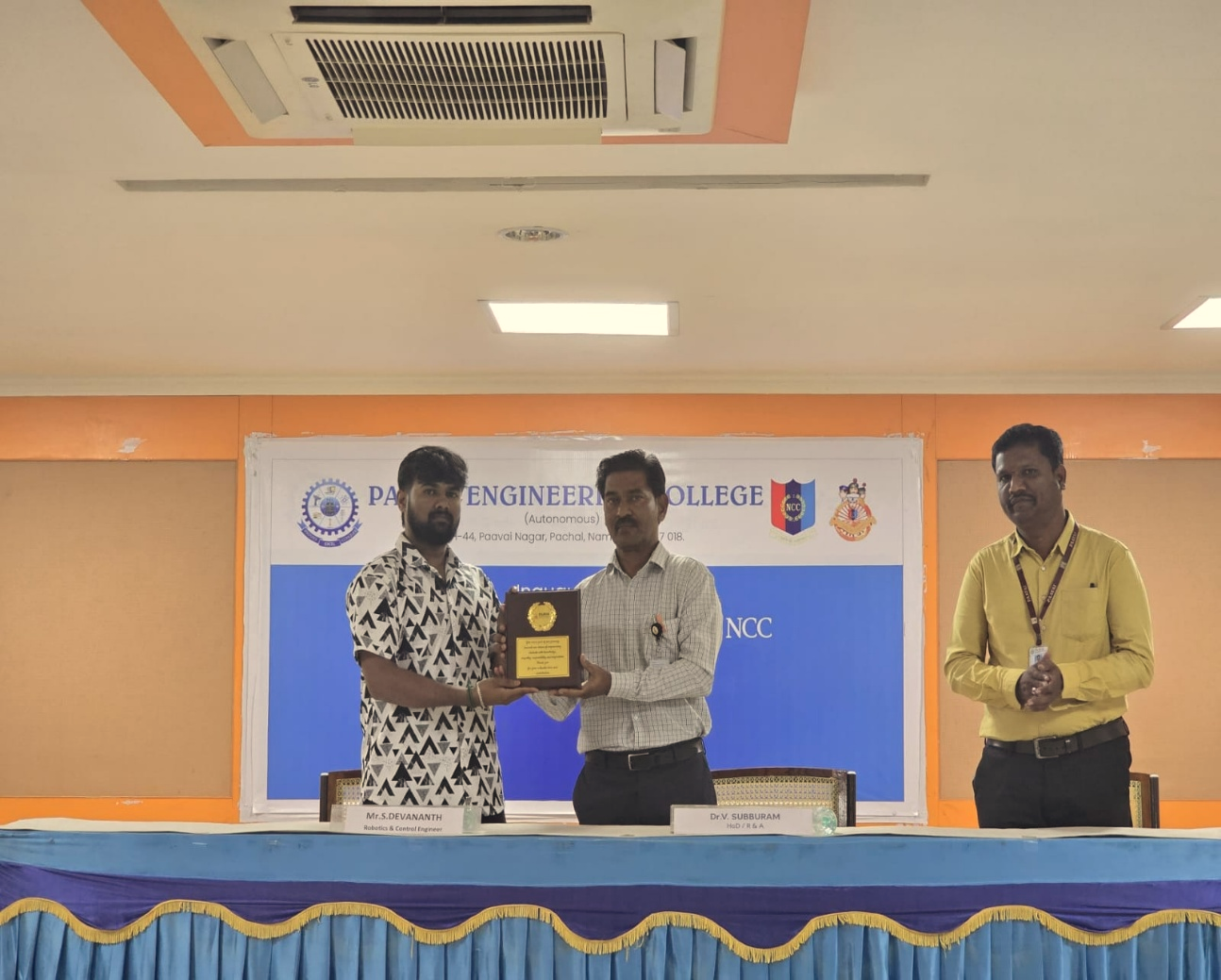
The Department of Robotics & Automation and association with RoboGenz club, Paavai Engineering College, organized one day workshop on “PLC Programming and Implementation of Logics” on 24.01.2026 in Cute Hall. The Chief Guest of the day was Mr. S. Devananth, Robotics and Control Engineer, Alstrut India Private Limited, Chennai. The program was coordinated by Dr. M. Matheswaran, Mr. K. Mohanraj, and Ms. K. Sathya, under the guidance of the Convener Dr. V. Subburam, HoD/R&A, and the Patron Dr. M. Premkumar, Principal.
A one-day workshop was organized to clear vision of PLC to students in automation and controller-based systems. The Guest speaker began the workshop by explaining the basic concepts of electrical systems and the various components used in PLC hardware. He highlighted how PLCs play an essential role in modern automation and why understanding their structure and functioning is important for future engineers.
During the forenoon session, he guided the students through the installation and setup of ZelioSoft2, the programming software used for Schneider PLCs. He explained the interface, features, and the purpose of each tool in the software. Students gained a clear idea of how PLC programming environments work and how programs are created, tested, and implemented.
The afternoon session focused on programming fundamentals. He introduced the concepts of Normally Open (NO) and Normally Closed (NC) conditions, then moved on to step-by-step procedures of developing different logic circuits. Topics included start/stop operations, input and output mapping, latching techniques, Memory concept and the use of timers. He explained the functions of ON delay and OFF delay timers, showing how timing plays an important role in automated systems.
Throughout the session, students worked directly on the software, applying the concepts through hands-on practice. They were given application-oriented problems to solve, which helped them understand how PLC logic is used in real industrial situations. The interactive exercises made the learning experience more effective and helped students strengthen their problem-solving skills. It helped them build confidence in working with PLC tools and automation-related tasks. The students participated actively and clarify their doubts.
The hands-on nature of the workshop made it especially valuable for students preparing for careers in automation and control engineering.
At the end of the session, he answered various questions raised by the students, providing clear and insightful responses. The students participated enthusiastically in organizing the program. The Third-year student Ms. S. Rithika Sri served as the Master of Ceremonies, Ms. P. Vijayadharsini introduced the Chief Guest, and Mr. S. Vengadesh delivered the Welcome Address and Ms. V. B. Sanjeetha gave the Vote of Thanks.