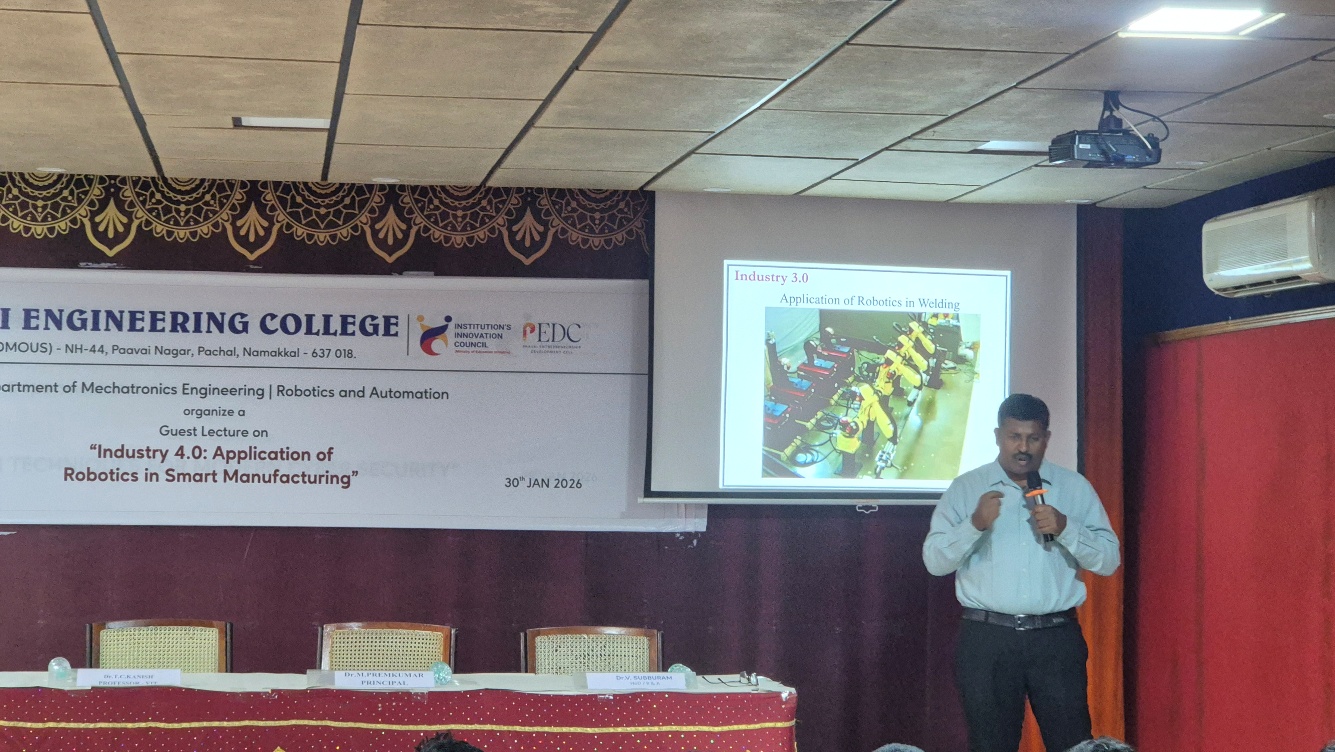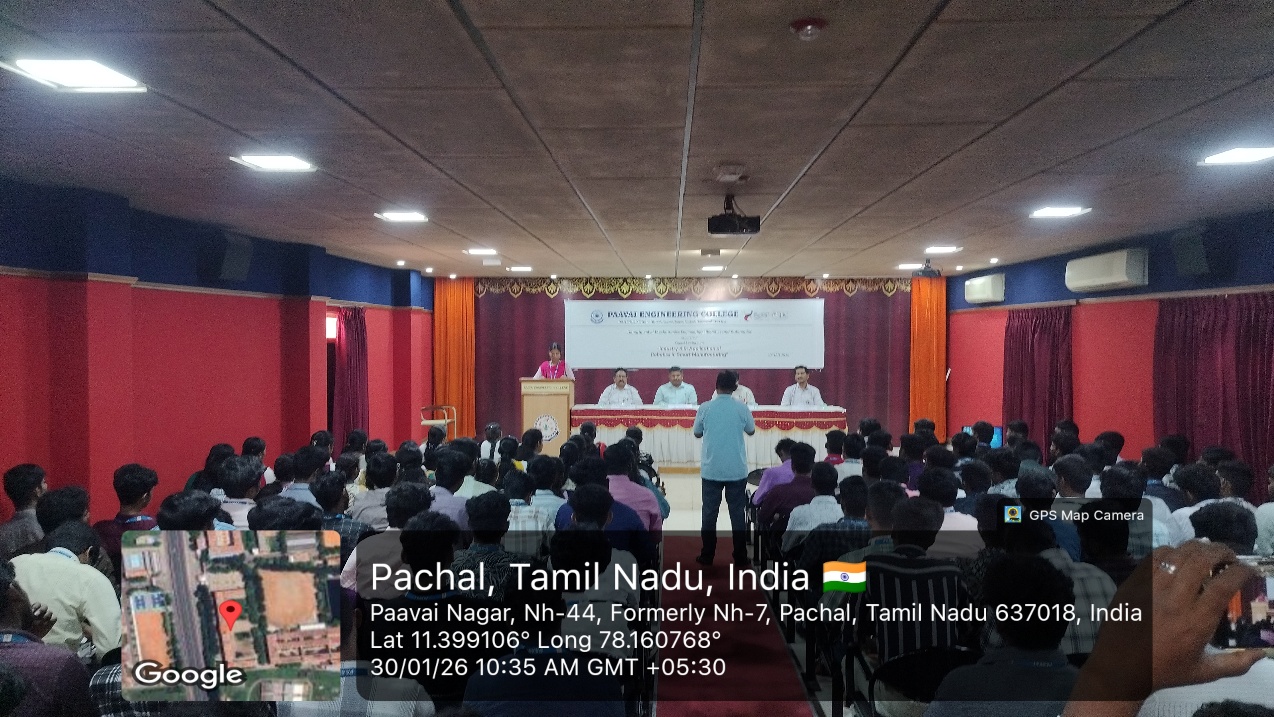
The Department of Mechatronics Engineering and Department of Robotics and Automation of Paavai Engineering College, in association with the Institution’s Innovation Council (IIC) and Paavai Entrepreneurship Development Cell (PEDC), organized a Guest Lecture on “Industry 4.0: Application of Robotics in Smart Manufacturing” on Friday, 30th January 2026, at 10:30 AM in Kalam’s Chamber.
The objective of this Guest Lecture was to provide students with insights into the evolution of industrial revolutions and the role of robotics in modern smart manufacturing systems. The session aimed to familiarize participants with the concepts of Industry 4.0, its key elements, and emerging trends such as Industry 5.0, thereby bridging the gap between theoretical knowledge and real-world industrial applications.
The Guest Lecture was delivered by Dr. T. C. Kanish, Professor, School of Mechanical Engineering, Vellore Institute of Technology (VIT), Vellore. The speaker provided an in-depth overview of the progression from Industry 1.0 to Industry 5.0, highlighting the technological advancements and paradigm shifts at each stage. Special emphasis was given to the nine key elements of Industry 4.0, including cyber-physical systems, smart factories, industrial automation, and the integration of robotics in intelligent manufacturing environments.
During the session, the speaker elaborated on the applications of robotics in smart manufacturing, illustrating how automation, sensors, data analytics, and artificial intelligence contribute to increased productivity, flexibility, and efficiency in industries. The discussion on Industry 5.0 offered students a forward-looking perspective on human-centric manufacturing and collaborative robotics. The lecture was interactive and enriched with practical examples, enabling students to relate academic concepts to industrial practices.
The Guest Lecture received enthusiastic participation from students and faculty members, with nearly 200 students attending the session. Participants appreciated the clarity, structured presentation, and relevance of the topic to current and future industrial requirements. The session encouraged students to think critically about emerging technologies and their applications in advanced manufacturing systems.
The lecture provided students with an opportunity to understand the practical implications of robotics and smart manufacturing technologies. Interactive discussions enabled participants to analyze real-world challenges, explore future research directions, and gain awareness of career opportunities in Industry 4.0–driven domains. The well-organized session successfully captured the interest of the audience and promoted active learning..
Conclusion:
In conclusion, this guest Lecture concluded as a highly informative and enriching academic event. By addressing Industry 4.0, robotics, and the transition towards Industry 5.0, the session significantly enhanced students’ technical knowledge and industry awareness. The positive feedback and active engagement from participants reflected the success of the program and reaffirmed its importance in supporting the academic and professional development of the students.
The session ended with a Vote of Thanks delivered by Dhanishkar.M.G, from Third year Mechatronics.