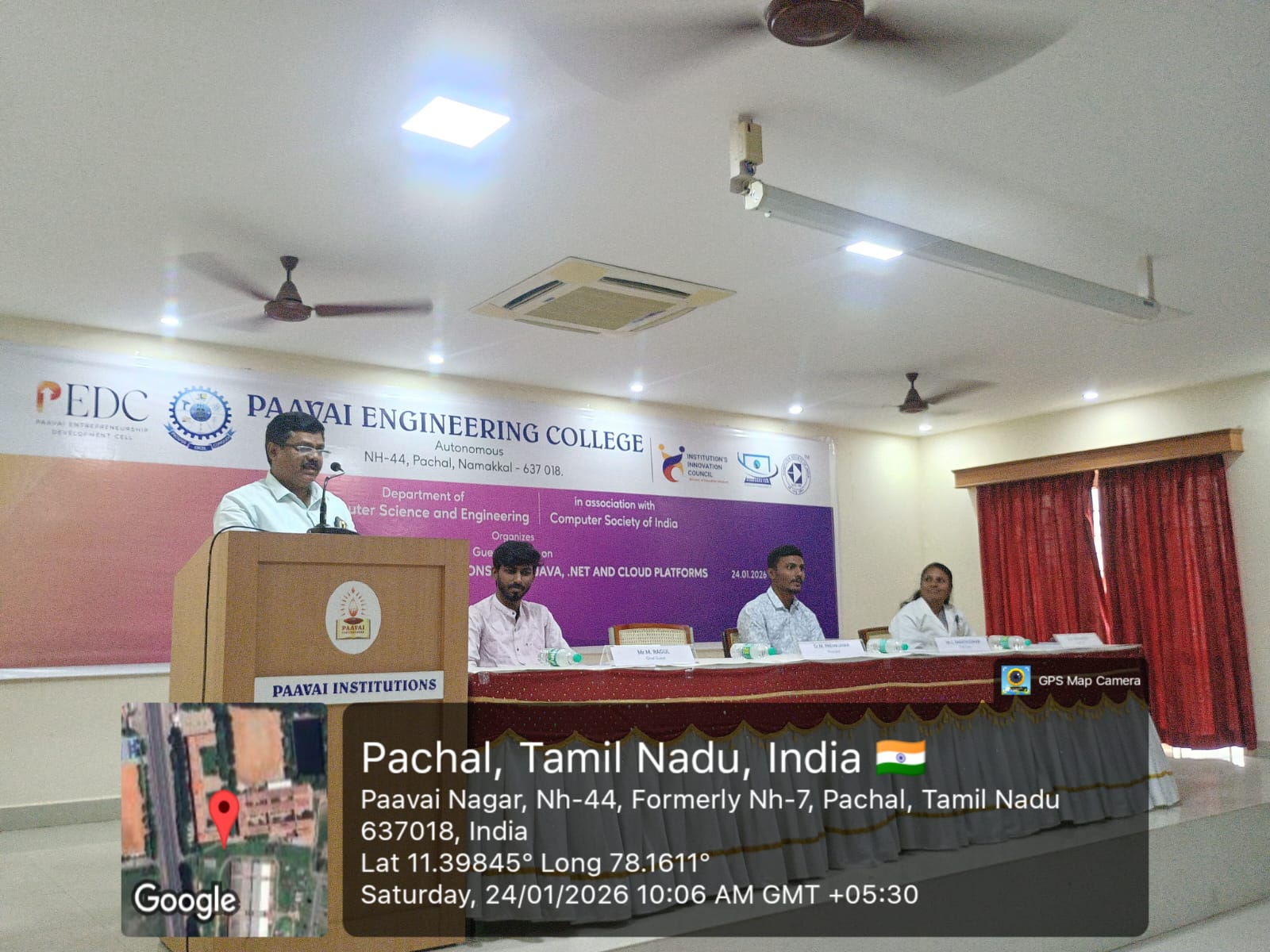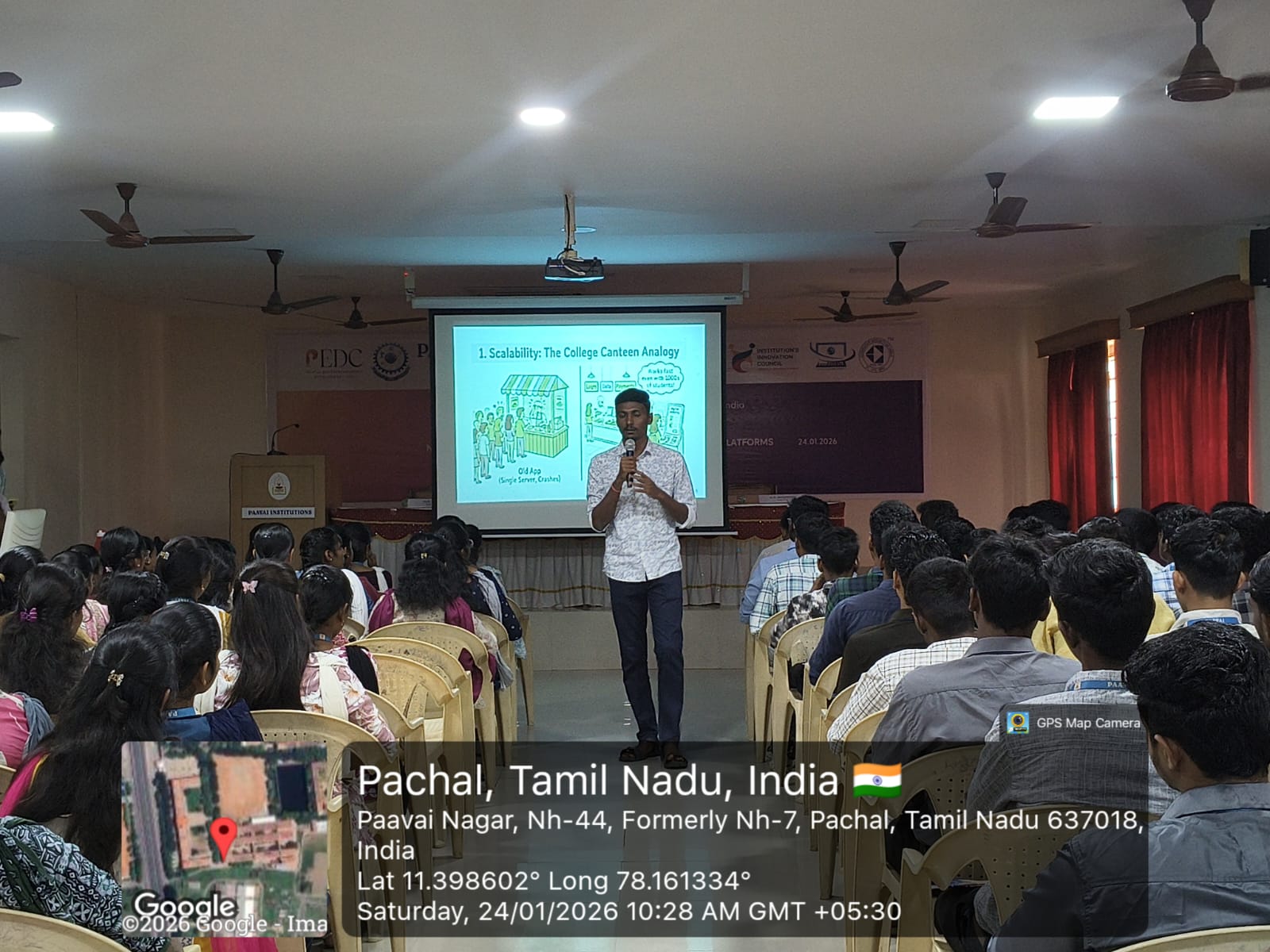
The Department of Computer Science and Engineering in association with IIC, CSI and Software Development & Information Management club organized a Guest Lecture “Next-Gen Scalable Applications Using Java, .NET and Cloud Platforms” on 24.1.2026. The objective of this session was to provide students with a comprehensive understanding of modern software development practices, industry expectations, and career pathways. It emphasized system reliability, scalability, and full-stack development while highlighting the transformative role of cloud platforms in today’s IT landscape.
The welcome address was given by E.Rajashree, II Year/CSE. The presidential address was given by Dr.M.Premkumar, Principal, Paavai Engineering College. He emphasized that today’s companies prioritize candidates who possess demonstrable skills, hands-on experience, and deep expertise over academic credentials alone. To succeed in tech landscape, he introduced students to the T-shaped learning strategy: the horizontal bar symbolizes a broad foundation across key areas such as programming fundamentals, databases, cloud platforms, and system design—ensuring students understand how different technologies interconnect-while the vertical bar represents deep expertise in at least one specialized domain, such as Java backend development, .NET ecosystems, cloud architecture. He encouraged every student to adopt the balanced learning, keep upskilling, and build portfolios that show both broad skills and deep expertise—qualities most valued by today’s top employers.
Mr. M. Ragul, Senior Software Engineer, HP, Bangalore and Mr. C. Barath Kumar, Software Engineer, Wells Fargo, Bangalore, highlighted the importance of Computer Science Engineering in driving innovation, explored IT career opportunities, and clarified the differences between service-based and product-based companies. Students gained insights into real-world incidents like the Microsoft crash, emphasizing the need for system stability and scalability, while also learning about servers, backend technology stacks, and the role of Java and .NET in building scalable applications. Key concepts such as full-stack development, APIs, databases, and cloud computing (Azure, AWS, GCP) were explained within the context of modern technical architecture, including microservices and cloud deployment.
Students showed active participation during the session by asking practical and thought‑provoking questions on internships, resume building, and the role of AI in IT, including whether AI might replace manual jobs. Their involvement made the session highly interactive, engaging, and valuable for connecting technical knowledge with real career concerns.
As a conclusion, the technical session was meticulously structured to provide students with a comprehensive understanding of contemporary software development practices, career pathways, and industry expectations. The session became even more valuable and productive, enriching students’ knowledge and preparing them for future opportunities in the IT field.
The vote of thanks was delivered by D.Harini, II Year/CSE. A total number of 350 students and the faculty members attended this guest lecture program.