The Department of Electrical and Electronics Engineering (EEE), Paavai Engineering College, successfully organized a Virtual Faculty Development Programme (FDP) titled “Intelligent Electric Mobility: AI-Driven Technologies for Next-Generation EVs” from 15th December 2025 to 19th December 2025. The five-day programme aimed to enhance faculty knowledge and expertise in emerging electric mobility technologies, with a strong focus on artificial intelligence applications in electric vehicles.
The programme commenced with a welcome address delivered by Dr. S. Suganya, Assistant Professor, EEE. The chief guests and resource persons for the sessions were introduced by Mr. R. Satheeshkumar, Assistant Professor, EEE, and Dr. C. Arulkumar, Associate Professor, EEE, over the course of the programme.
Day 1 – 15.12.2025
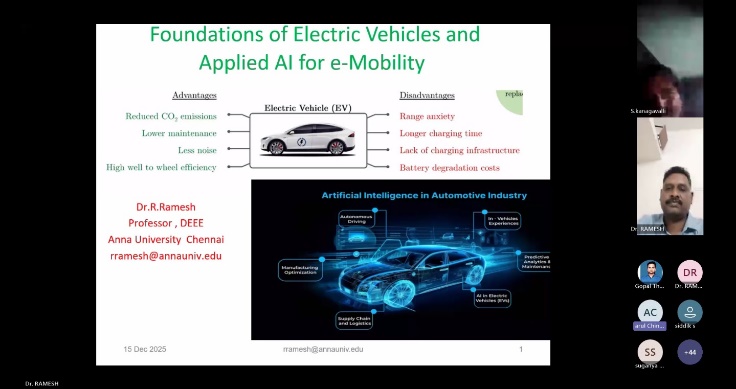
Session Title: Foundations of Electric Vehicles and Applied AI for e-Mobility
Resource Person:
Dr. R. Ramesh
Professor, Department of EEE,
College of Engineering Guindy (CEG), Anna University, Chennai – 25
Time: 7.00 PM – 8.30 PM
Session Summary:
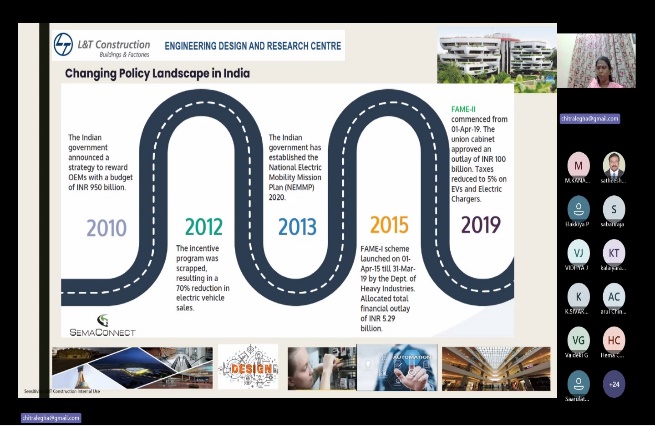
The session introduced the fundamental architecture of electric vehicles, including electric powertrain components, batteries, power electronics interfaces, charging infrastructure, and vehicle control concepts. The resource person provided an overview of the e-mobility ecosystem, highlighting recent technology trends, policy initiatives, and the increasing role of EVs in sustainable transportation systems.
Session Title: High Voltage Systems in Electric Vehicles
Resource Person:
Dr. R. Kannadasan
Industry Expert, EV Powertrain and High-Voltage Systems,
TVS Motor Company, Hosur, Tamil Nadu
Time: 7.00 PM – 8.00 PM
Session Summary:
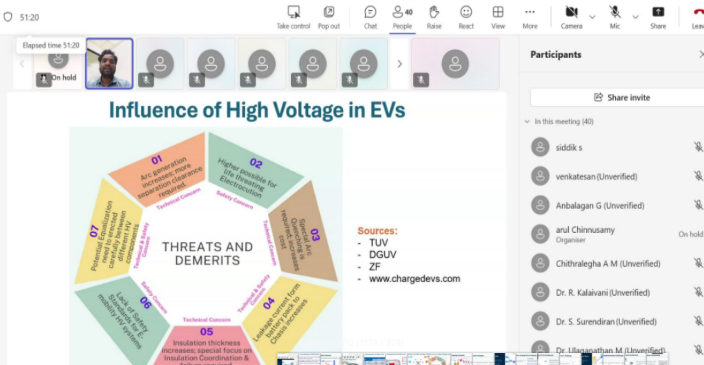
This session focused on the architecture of high-voltage systems in EVs, including traction battery packs, inverters, DC–DC converters, onboard chargers, and auxiliary systems. Key design parameters such as voltage levels, insulation coordination, creepage and clearance distances, and safety standards were explained. Emphasis was placed on high-voltage safety, diagnostic strategies, and best practices followed in EV manufacturing and service environments at TVS Motor Company.
Session Title: Smart Charging, AI, and Grid-Interactive EV Systems
Resource Person:
Mrs. Chitralegha A. M.
M.E., Senior Manager (MEP),
Larsen & Toubro Ltd., Chennai
Time: 7.00 PM – 8.00 PM
Session Summary:
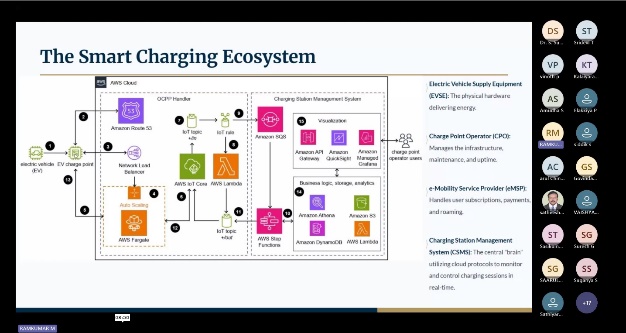
The session covered smart EV charging concepts, including dynamic charging control based on grid conditions, electricity tariffs, and user demand. AI applications such as machine learning-based demand forecasting, charging optimization, and predictive maintenance of charging infrastructure were discussed. The session highlighted methods to reduce charging costs, energy losses, and emissions while ensuring grid stability and user convenience.
Session Title: Autonomous and Connected Electric Vehicles using AI
Resource Person:
Dr. Ramkumar, M.E., Ph.D.
R&D Specialist, Royal Enfield, Chennai
Time: 7.00 PM – 8.00 PM
Session Summary:
The session explained the role of AI in autonomous and connected electric vehicles. Topics included sensor fusion using cameras, radar, LiDAR, and IMU, AI-based perception models, trajectory planning, and control strategies. Reinforcement learning and rule-based decision-making techniques for autonomous maneuvering were discussed, along with challenges in real-time implementation and safety-critical applications in EV platforms.
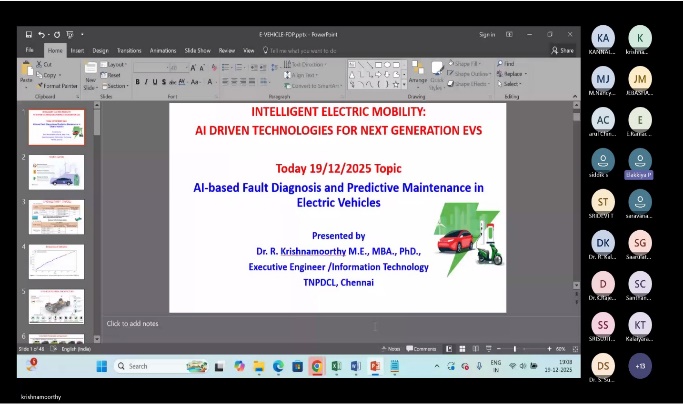
Session Title: AI-Based Fault Diagnosis and Predictive Maintenance in Electric Vehicles
Resource Person:
Dr. Krishnamoorthy R.
Power Systems Expert,
Tamil Nadu Electricity Board (TNEB), Chennai
Time: 7.00 PM – 8.00 PM
Session Summary:
The final session focused on common EV faults such as battery degradation, inverter failures, motor faults, and sensor errors. AI-based diagnostic techniques using supervised learning, deep learning, and hybrid models were explained. Case studies demonstrated how data-driven models can detect incipient faults earlier than traditional methods, improving reliability, safety, and maintenance efficiency.
Outcome of the Programme
The FDP significantly enhanced participants’ understanding of electric mobility systems, AI-based control, safety, smart charging, autonomous EVs, and predictive maintenance. Faculty members gained valuable insights into current industry practices and research directions, enabling them to incorporate advanced EV and AI concepts into teaching and research activities.
Conclusion
The five-day Virtual Faculty Development Programme was successfully conducted with active participation from faculty members. The programme effectively bridged the gap between academia and industry, contributing to professional development in the rapidly evolving field of AI-driven electric mobility.